

CULTURE + TRAVEL
Unless you have a title, or an in at the palace, it is unlikely you will ever be invited to stay at one of Britain’s stately homes. However, it is far easier than you might think to spend the night, or even a fortnight or two, in an architectural gem on the grounds of one of these great country houses—and without all the fuss of having to know if you must dress for dinner, which fork to use, and whether or not you will be expected to ride to hounds.
In fact, many of the follies and outbuildings of grand country houses are available for lease, through such organizations as Britain’s National Trust, English Heritage, and the Vivat Trust. Over the past 40 years, the Landmark Trust has assembled a magnificent collection of follies, rescuing as many of these little architectural treasures as possible, and renting them out as vacation getaways to pay for their upkeep.
Renting a folly not only gives unprecedented access—you can have cocktails and watch the sun set over a legendary landscape after all other visitors have gone, and you can breakfast surrounded by birdsong. More importantly, it also allows you to become intimately acquainted with centuries of history and generations of the eccentricities of some of England’s most fabled families.
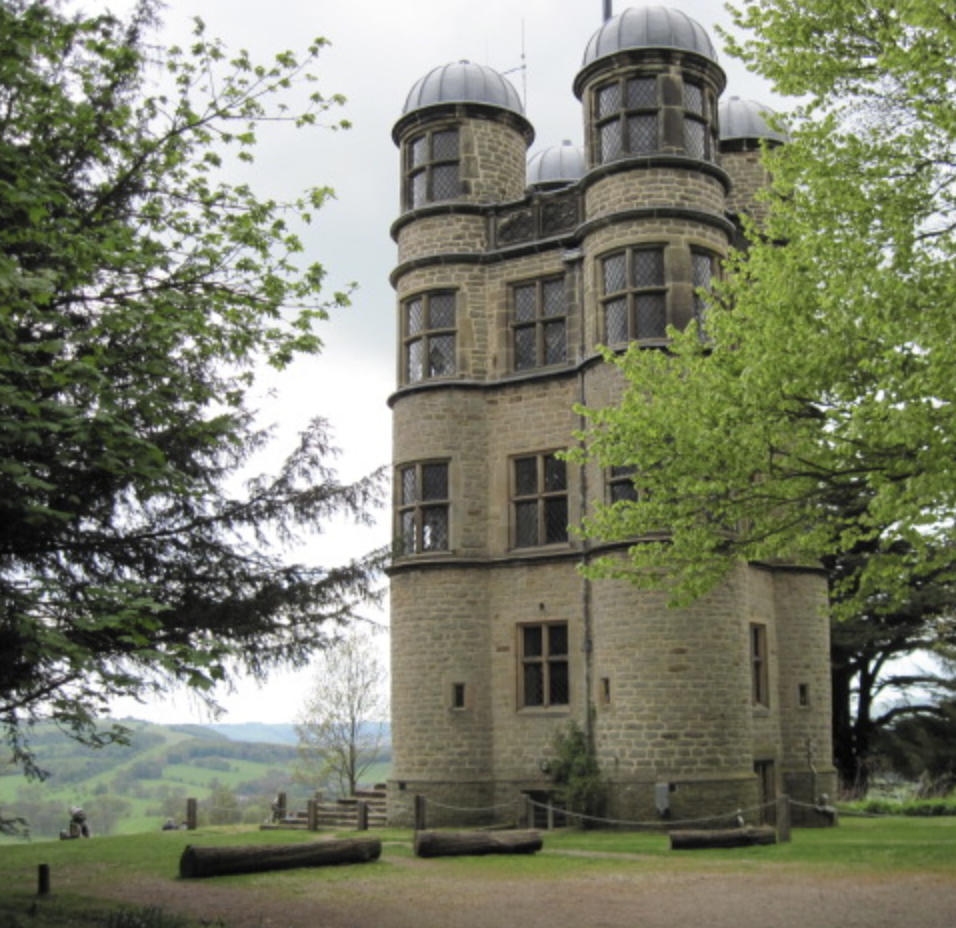
For example, not only does a stay at the Hunting Tower at Chatsworth provide the thrill of sleeping in a four poster made by Lord Snowdon, in the rooms where Prince William lodged just a year or two ago, but the tower is situated a mere 400 feet from one of Britain’s most popular historic homes, where the aristocratic owners are still very much in residence.
Until recently, Chatsworth and its estate were occupied and run by the Duchess of Devonshire and her husband, the 11th Duke of Devonshire. After the 11th Duke’s death in 2004, the estate passed to their son, the 12th Duke of Devonshire, and his wife, and the dowager duchess moved to a more modestly scaled house in the nearby village of Edensor. But Chatsworth today remains very much a testament to her personality.
In her hilarious and highly opinionated memoir, Counting My Chickens, the Dowager Duchess reveals that at Chatsworth, the family has never tiptoed around the priceless gewgaws. On the contrary, children roller-skate down corridors, granny bangs the furniture with a mallet to give the woodworm concussion, and birds fly in through open windows “and choose the best pictures on which to make their messes.”
Of course, the dowager grew up in a house where eccentric behavior was the norm. She is the last remaining Mitford sister, known to her family as “Debo.” For entertainment, her father hunted her older sisters with bloodhounds (much to the astonishment of their neighbors), and the 19-year-old Debo thought nothing of taking her favorite goat on a train from Scotland to London and milking it in the first-class waiting room.
It was the duchess’s idea, in 2003, to turn the Hunting Tower into holiday accommodation and rent it out. She also personally decorated the interior with paintings and books from Chatsworth, including watercolors from her husband’s private collection. The furniture is nothing grand. As one London newspaper griped, “It’s more IKEA than Thomas Chippendale or Grinling Gibbons.” But it is probably a true reflection of the duchess’s practical taste. In her memoir, she admits to preferring clothes bought at agricultural shows and Marks & Spencer (a mundane British department store) rather than “the strange looking garments in desperate colors at one thousand pounds each in Knightsbridge shops.”
The Hunting Tower is a spectacular landmark structure with a magnificent 360-degree view over the Chatsworth estate. It was built in 1582 by architect Robert Smythson for the Elizabethan aristocrat and original mistress of Chatsworth, Bess of Hardwick. The tower was designed so that she and her lady friends could follow the hunt below. Bess went on to commission Smythson to build her beloved Hardwick Hall (an easy trip from Chatsworth and open to the public) and, like Hardwick, the Hunting Tower showcases Bess’s love of glass and retains some original Elizabethan plasterwork.
The slim Hunting Tower comprises four floors and a tiny rooftop terrace. On the top floor is a bedroom with a flagpole that runs through the middle. There is a shower in one turret, and a toilet in another. On the third floor is a living room, below that a kitchen and dining room, and on the ground floor, a second double bedroom. Connecting all the rooms is a spiral stone staircase that runs up 82 steps. This is not a vacation retreat for the exercise-challenged.
If you would prefer not to have Britain’s landed gentry right on your doorstep, you might consider one of the Landmark Trust’s latest acquisitions, the Ruin at Hackfall in North Yorkshire. When the Ruin was built in the mid-18th century, follies, and even the occasional full-time hermit, were all the rage. These small architectural wonders were designed to entertain country houseguests on tours of the great estate gardens. The gardens at Stowe in Buckinghamshire, landscaped by Capability Brown around the same period, are stippled with dozens of follies, including a grotto, Gothic Temple, Chinese House, a “Temple of Ancient Virtue”, and Dido’s Cave.
Hackfall once boasted a similar array of architectural miniatures, including a “ruined” Gothic castle and a rustic temple. These fanciful creations were highlights of Northern England’s great romantic gardens. But today, all are in ruins except the Ruin. It is perhaps the most significant of all the buildings. During its restoration, the Landmark Trust uncovered a startling bit of information about its provenance.
A watercolor was found in the archives of London’s Victoria and Albert Museum that depicts an identical building. It is signed by Robert Adam, who many consider the greatest British architect of the 18th century. He was responsible for Fitzroy Square and Portland Place in London and for designing over a dozen of Britain’s stately homes, including Kenwood House, Syon House, and Culzean Castle. “It is too great a coincidence not to have some connection,” remarks Landmark historian Caroline Stanford. “Either the ruin is based on this watercolor by Adam, or there is an outside chance that Adam designed the Ruin.”
the same period, are stippled with dozens of follies, including a grotto, Gothic Temple, Chinese House, a “Temple of Ancient Virtue”, and Dido’s Cave.
Hackfall once boasted a similar array of architectural miniatures, including a “ruined” Gothic castle and a rustic temple. These fanciful creations were highlights of Northern England’s great romantic gardens. But today, all are in ruins except the Ruin. It is perhaps the most significant of all the buildings. During its restoration, the Landmark Trust uncovered a startling bit of information about its provenance.
A watercolor was found in the archives of London’s Victoria and Albert Museum that depicts an identical building. It is signed by Robert Adam, who many consider the greatest British architect of the 18th century. He was responsible for Fitzroy Square and Portland Place in London and for designing over a dozen of Britain’s stately homes, including Kenwood House, Syon House, and Culzean Castle. “It is too great a coincidence not to have some connection,” remarks Landmark historian Caroline Stanford. “Either the ruin is based on this watercolor by Adam, or there is an outside chance that Adam designed the Ruin.”
The Ruin would have been the grand finale of a magnificent tour of Hackfall gardens, which were designed by John Aislabie and his son William, who also designed the famous water gardens at Studley Royal.
The two very different façades of the Ruin were typical of follies in the 18th century. As you approach it from the road, the Ruin looks like a small banqueting house with a smooth Augustan façade of precisely laid yellow stone. Inside, the main room is sweetly decorated in a pale greenish-blue that has been carefully copied from flakes of the original paint. Here, guests would have been offered refreshments and afterward ushered through folding doors onto a balustraded terrace at the back of the pavilion to gasp at the views over the Vale of Mowbray, which extend to York in one direction and Durham in the other. Guests would also be delighted to discover that they were now standing in the midst of what appeared to be a crumbling, triple-domed building redolent of ancient Rome and the designs of Piranesi.
The Ruin was in a desolate state when the Landmark Trust took it over. It was so fragile that it was in danger of tipping over into the gorge. According to Stanford, it took local masons many months to stitch it all back together. To maintain the structural integrity of the interior, Landmark decided not to break through the walls and connect the three rooms, which means guests have to go outside when moving between the living area, the bedroom, and the bathroom. But the Ruin is sufficiently remote that no one will notice you nipping outside in the starlight. “It is the most wonderful little aerie,” observes Stanford.
Landmark’s most eccentric, and by far its most photographed, folly is a 37-foot-tall stone pineapple in Dunmore, Scotland. Local lore has it that John Murray, the 4th Earl of Dunmore, got the idea for this structure while serving as the governor of Virginia. In 18th-century America, pineapples were a symbol of friendship and hospitality, and American houses often sported carved wood or mortar pineapples on their gate posts. The Earl went one better with his massive fruity edifice.
In 18th-century Scotland, pineapples were an extremely rare and exotic luxury, so this folly must have been a bizarre and somewhat outlandish sight to locals. Situated within a walled garden (now run by the National Trust for Scotland and open to the public), the pineapple sits atop an octagonal summerhouse with Gothic windows and carved stone foliage that appears to hold up the bottom of the giant fruit. The adventurous earl, eager to grow pineapples himself, had the garden walls equipped with pipes to channel heat into the garden, transforming Scotland’s bracing weather into an acceptable microclimate for exotic fruits.
Today, guests have a wonderful view over the garden from the summerhouse. The main accommodation, however, is in the two-story pavilion on either side of the pineapple, which originally served as simple gardeners’ cottages. The interiors are fairly rustic. But that surely doesn’t matter much, since visitors are far more likely to spend their time exploring the surrounding area than lingering inside.
The pineapple is perfectly situated between Glasgow and Edinburgh (40 minutes by car in either direction), and there is an abundance of important architecture nearby, such as the 37-mile-long Antonine Wall built by the Romans in the 2nd century and the 15th-century Rosslyn Chapel, which The Da Vinci Code made famous. It is exactly that kind of history that renting a folly brings to hand—in the surrounding areas, right outside the front door, and even at your bedside table.
 Lucie Young