
INDEPENDENT ON SUNDAY
Frank Lloyd Wright, America’s best-known architect, was famously controlling. He insisted his wife wear the same brown color as the interior of their home. He moved their front door three times and on weekends he constantly rearranged the furniture. She got no thanks for all her pains. One day, he upped and left her for a client.
Wright met his match in one of his clients, the equally controlling and difficult oil heiress Aline Barnsdall. In 1919, she commissioned him to design Hollyhock House on 36 acres of land in the middle of Hollywood Boulevard, Los Angeles. In 2019, the house was listed as a UNESCO World Heritage Site (the only one in Los Angeles). Wright’s son Lloyd remarked of his father’s alliance with Barnsdall that, ‘She could have anything she liked, so long as it fit with Wright’s vision’.
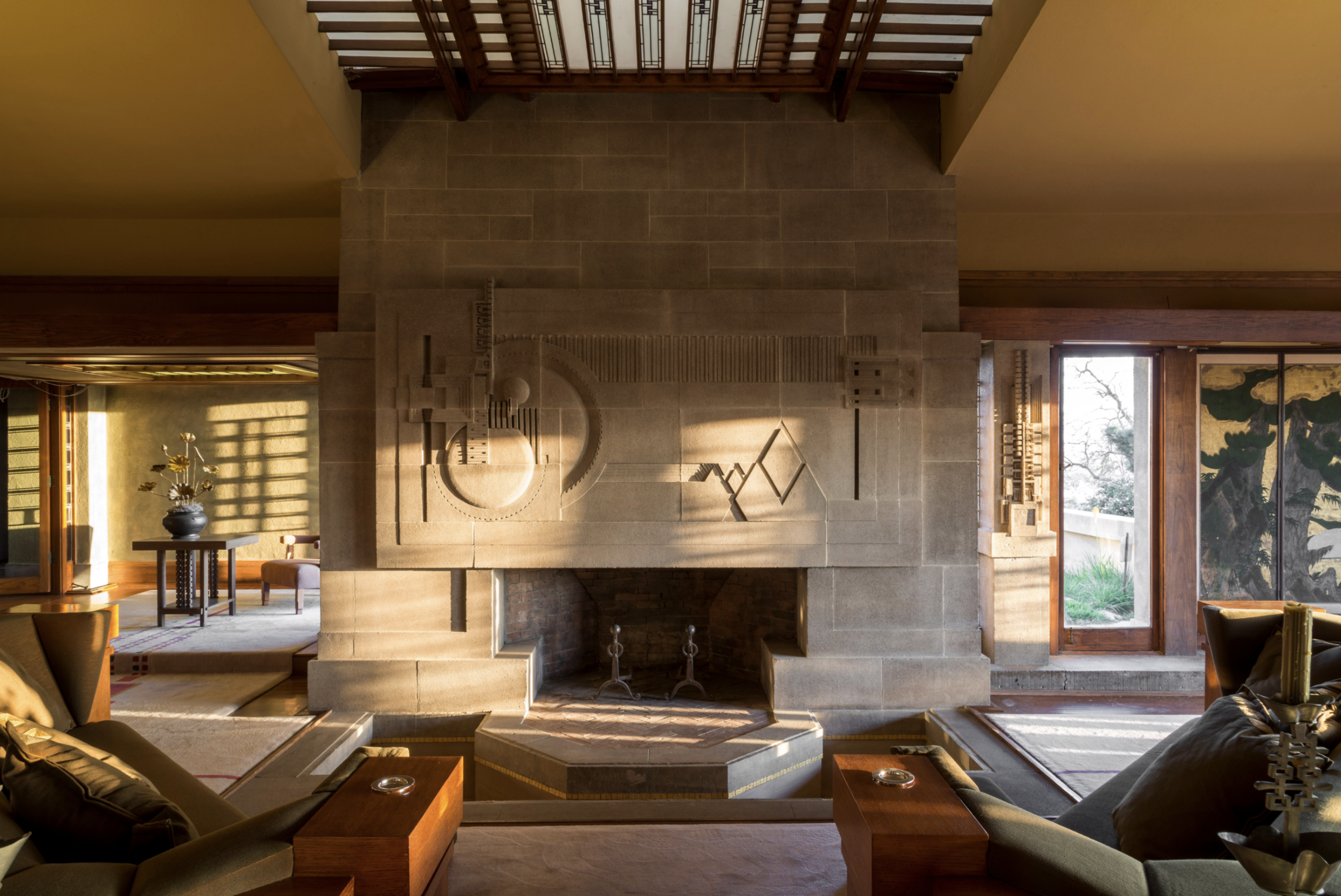
She wanted first and foremost a theatre and arts complex. She got a Mayan looking residence and two guesthouses. She wanted a place to hang her fabulous collection of European paintings (including Corots, Lautrecs and Monets). She got a living room full of Wright’s favorite Japanese screens. She wanted a house that cost $20,000. One guesthouse cost that much. The whole project came in at nearly $200,000 for the architecture and $300,000 for the land.
Aline Barnsdall hired and fired Frank Lloyd Wright twice during the building of the house and acrimonious letters flew between them. At one point, Aline discovered that the Japanese screens Wright had sold her for $120, were valued at just $25-$30. In response to her accusations of swindling, Wright sent over a sheriff who woke her with a summons, searched the house and repossessed the screens. She quickly posted a $100,000 bond and recovered them. Despite these feuds, Wright and Barnsdall remained friends until her death in 1946. She even sent her daughter ‘Sugar Top’ to study at Wright’s Taliesin West architecture school.
Hollyhock House, named after Barnsdall’s favorite flower, is considered one of Wright’s most significant works in America. Wright later went on to build the Guggenheim Museum in New York, the SC Johnson & Son factory in Wisconsin with its tapering dendriform columns, and most famously, Falling Water in Pennsylvania, a house which seems to cascade off the top of a waterfall, perfectly integrating inside and out.
In 1919, when Wright started work on Hollyhock House, his career was in a slump. His partner Mamah Cheney, her two children and four other people had been murdered by a crazed servant who set fire to their home. Up until this period Wright worked solely in the Mid West creating his ‘Prairie Style’ houses that mimicked the American farmhouse in their noble simplicity and their long horizontal planes.
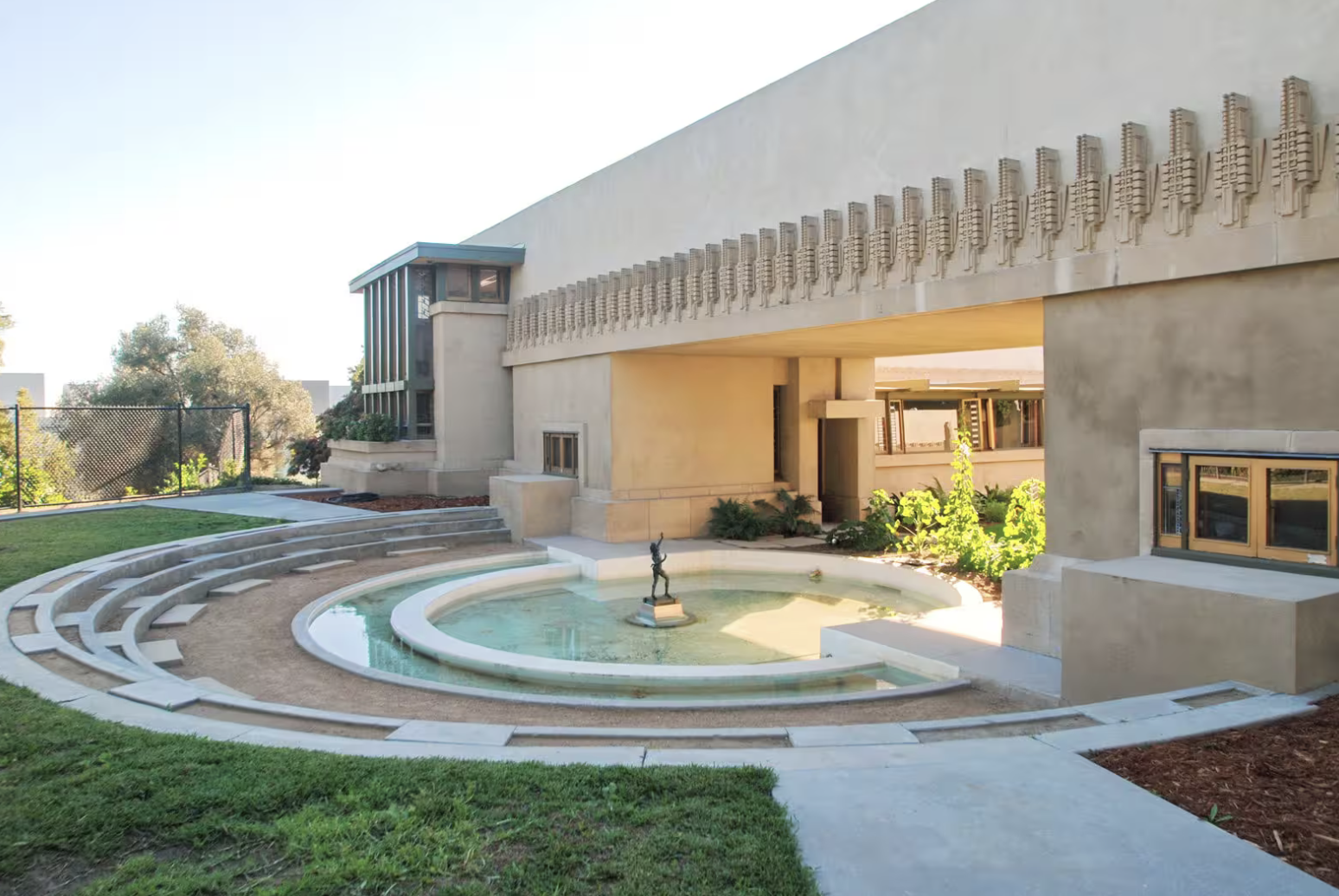
Hollyhock House was a total departure. It looks like a miniature temple with a veritable headdress of masonry. Outdoor stairways lead up to the sky. Poking up all around the parapet are elaborate finials which close up reveal little faces pulling out their tongues (probably a piece of Wrightian mischief aimed at his client).
Wright had attended the World’s Exposition of Columbian Art in Chicago in 1893. Most critics assume Hollyhock House was inspired by the fair’s recreations of Yucatan ruins. But Wright insisted on his originality. ‘The whole is invention,’ he said. Wright considered the house a little principality for the daughter of one of America’s great pioneers. Aline Barnsdall was the grand-daughter of William Barnsdall, a shoemaker from Bedford, England, who came to America in the early 19th century and drilled the second oil well in the world. Aline’s father Theodore became the wealthiest man in Pittsburg with his gold, silver, zinc, lead, iron and coal mines.
The main living room feels like a shimmering oasis. The walls are painted gold and wrapping the fireplace is a gold tiled pool. 7-foot high torcheres rise out of wood tables behind the sofas and throw light up on to the ceiling. The overstuffed armchairs are angled to reflect the slope of the exterior walls and the windowpanes are tinted violet (the color of the desert shadows) and green (the color of the surrounding olive trees).
In contrast to the grand scale of the public parts of the house, Wright created several smaller more intimate rooms such as the dining room nook with its table for 6 (Aline didn’t like entertaining on a grand scale). The master bedroom is a magical space, with its stained glass sleeping porch perched up among the treetops. But Aline never slept there. The furniture for the second floor was never finished, partly because she had fallen out of love with the project. She complained that the house was too big and not comfortable. It didn’t feel like home. For Aline, no place felt like home. She had houses all over America and never lived anywhere for more than 5 years.
Leaks were the biggest problem with the house. ‘Build yourself a Frank Lloyd Wright house if you don’t mind standing outside when it rains,’ Aline wrote to a friend. in the first 6 years after the house was built, flooding was so bad that the living room carpet was replaced 2 or 3 times says Virginia Ernst Kazor who has been Historic Site Curator for Hollyhock House since it first opened to the public in 1974. Whenever it rained heavily, the indoor pool also flooded because it was linked to two outside pools by an underground channel. At one point, Wright became so exasperated with the leaky house he wrote, ‘Let’s forget it. The damned thing will float away some day and be forgotten.’
Disenchanted with her dream home, Aline Barnsdall took up residence in one of the guesthouses and bequeathed the main house and 11 acres of land to the City of Los Angeles. The house was opened to the public for the first time in 1974, but the Northridge earthquake of 1994 caused extensive damage and the house was closed for 10 years. The house reopened in the summer of 2005 in its finest incarnation since Wright and Barnsdall’s era. ‘My entire career has been about restoring this living room,’ says Virginia Ernst Kazor looking around the place with a look of delight.
10 Frank Lloyd Wright buildings open to visitors
1. Hollyhock House – Los Angeles, CA
Completed in 1921 for Aline Barnsdall. Now a UNESCO World Heritage site. It is open for visits 3 days a week.
hollyhockhouse.org
2. Frank Lloyd Wright Home & Studio – Chicago, Illinois
Wright’s own house. He changed the front door 3 times and insisted his wife Catherine wore dun colored clothes so as not to clash with the décor. Built in 1889.
flwright.org
3. Frederick C Robie House – Chicago, Illinois
Wright’s consummate Prairie style house built in 1906. A UNESCO World Heritage Site.
flwright.org
4. Falling Water – Mill Run, Pennsylvania
Also known as the Kaufmann House, Wright’s masterpiece is a series of cantilevered concrete planes that hang out over a waterfall blending with the rock formations underneath. Built in 1935. One of 8 Wright buildings to be listed as a UNESCO World Heritage Site.
fallingwater.org
5. The Guggenheim Museum – New York, New York
The building’s curvaceous spiraling form (compared by critics to a washing machine or a cereal bowl) is characteristic Wrightian snub to the conformity of the city, refusing to line up with the gridiron street pattern, built in 1956. A UNESCO World Heritage Site.
guggenheim.org
6. Taliesen (Wright’s Wisconsin home) – Spring Green, Wisconsin
Wright’s 37,000 sq ft home, studio and school, and 800 acre estate, where he lived for 50 years. A National Historic Landmark and UNESCO World Heritage site since 2019.
taliesenpreservation.org
7. SC Johnson + Son Administration Building – Racine, Wisconsin
Over 200 different types and shapes of brick were used to create this futuristic factory building. The tapering dendriform columns inside extend up more than 20 feet and look at the top like giant lily pads. Built in 1936
scjohnson.com
8. Taliesen West – Scotsdale, Arizona
Wright’s desert laboratory. A UNESCO World Heritage Site.
franklloydwright.org
9. Unity Temple – Chicago, Illinois
Commisioned by the congregation of Oak Park Unity Church in Chicago. The Unity Temple was built in 1905. It is now a UNESCO World Heritage Site
flwright.org
10. Herbert & Katherine Jacobs House – Madison, Wisconsin
Challenged by the owners to build a house for $5,000, this was Wright’s first attempt at creating affordable domestic architecture in the depression stricken 1930s. Now a UNESCO World Heritage Site.
franklloydwright.org
 Lucie Young