

TELEGRAPH SATURDAY MAGAZINE (UK)
Several hours into a meal at The French Laundry, it is entirely possible to be still feasting on appetizers and not yet to have tasted a main course dish. After 8 or 10 courses, some diners feel a short nap or walk around Yountville, the local Napa Valley town, might be in order, but the dishes keep coming, sometimes as many as 20 exquisite little courses stretch lunch out into a 6 hour feast. Once chef Thomas Keller is on a roll, he will start adding new dishes on a whim. Concocting new surprises, based on his perception of what you have liked and disliked so far.
The French Laundry is the Holy Grail for American foodies. Diners who manage to bag a coveted booking at this shrine of American culinary excellence bring back stories of delight and excess that are the envy of their friends and colleagues, many of whom have tried without success for months or even years to get in.
The tasting menu is the most spectacular option at this quaint looking establishment, a former brothel, built of rough hewn stone and draped with honeysuckle and wild roses. The tasting option features course after course of minute morsels each more spectacularly presented than the last. Each dish is perched atop an architectural folly of white porcelain plates. A tower of 6 dishes is not unusual and diners often peer inside to find just one perfect quail’s egg or scallop surrounded by a halo of ‘fennel dust’ or ‘pepper confetti’. Presented with such folderol, it is hard not to stifle a giggle, until you become caught up in the wave upon wave of heavenly flavors. After several courses, it is impossible not to overcome all reservations and eagerly await the next visual and taste surprise.
Thomas Keller grew up on the East Coast of America on a diet of spaghetti and cottage cheese. His first real job was flipping hamburgers and his first career thought was to become a carpenter. He is the most unlikely character to become America’s top chef – someone who is now so meticulous about food that he will sieve a sauce 20 times before he considers it sufficiently silken to serve. His perfectionism verges on the excruciating. He refuses to use plain old pan lids for cooking pots preferring to make his own individual non reusable parchment lids because ‘they allow the meat and vegetables to breathe’.
He is a large man, 6 foot 2 inches with big square hands. It is a surprise to see him delicately chopping herbs or boning a quail bent double over the work tops at The French Laundry kitchen. The 600 square foot space seems far too small to serve 80-90 covers a night and use up 1,200 dishes in the process. But Thomas likes to work in a compact space with his 83 person staff in easy view.
Unlike many a top chef whose name and not much else is attached to their restaurant, Thomas is in the kitchen 7 days a week virtually year round. He lives a skillet’s toss away in one of the outbuildings and his girlfriend Laura Cunningham is the restaurant’s lithe, elegant general manager. ‘When I mess up she catches me,’ he says proudly. It is a terrifying thought, considering how exacting he already is.
Next year this small California enterprise will blow up into a national corporation with the much heralded opening of Per Se in New York (slated for February 2004), the opening of three Bouchon Bakeries; one in Las Vegas, one in New York and the newly opened one in Yountville. Then there is the expansion of the original French Laundry to include a new 20 room inn. Apparently, it has only just come to Thomas’s attention (after 9 years in Yountville) that his dinner guests are often in no state to drive home after a 6 hour meal. Eight of the world’s top architects applied for the job of designing the inn, including Frank Ghery and Arata Isosaki, but Thomas chose Antoine Predock, the least flashy of the bunch and the architect most likely to create an environmentally sensitive building which blends seamlessly with the surrounds.
Jetting back and forth to New York shouldn’t be too much of a stretch for Thomas. ‘He doesn’t know how to relax and take time off,’ his pr woman says with a shrug. Occasionally he will go to a friend’s houses and cook dinner as a sort of a busman’s holiday. Thomas likes to cook for friends, partly because he has no social alternative. ‘Most people are afraid to cook for me, even though cooks are the easiest people in the world to cook for. It’s such an honor when someone cooks for me, I am twice as appreciative and I never criticize,’ he says.
Today he is cooking for the Sinskeys who live 20 minutes down the valley. They own five small vineyards in the area and are renowned for their pinot noir, which Thomas serves in his restaurant. Maria Helm Sinskey a former chef at the Plumpjack Café in San Francisco has just written The Vineyard Kitchen cookbook full of hearty meals that anyone can do. Thomas is an old friend, but familiarity hasn’t dulled her awe of him. ‘A meal at his restaurant is an unforgettable experience. I am still dazzled by him. I wouldn’t let anyone else use my kitchen,’ she says firmly.
Despite the nearly vertiginous difficulty of the food in his restaurant and his luxurious looking The French Laundry Cookbook, Thomas likes to keep things simple when dining with friends or at home where he opts for one pot dishes like chicken and veg thrown in together because it minimizes the effort and clean up. He cooks simply he says, partly because his house is not equipped for entertaining (‘ I bought a stove, washer dryer and fridge for $1,000 when I moved in, so you can imagine how it looks,’ he chuckles) but also he believes entertaining is about the guests as much as the food: ‘so you don’t want to spend time in the kitchen unless you have to and should prepare as much as possible ahead of time’.
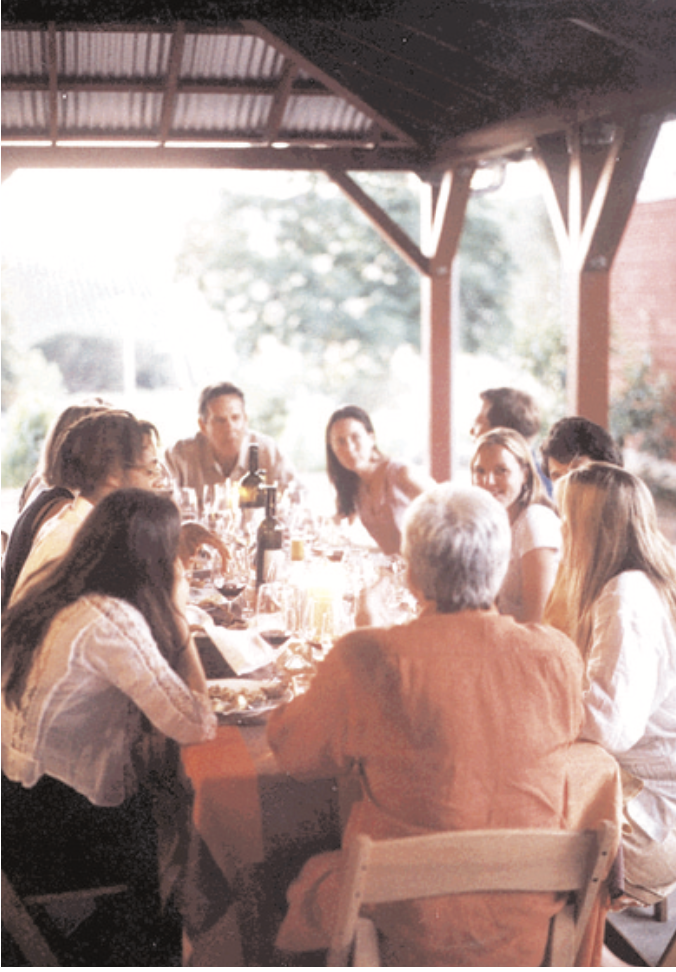
Preparations for the Sinskeys dinner party start at 11 am on the day. Thomas’s girlfriend Laura turns up first with a carload of boxes filled with plates, silverware and glasses. The sinskeys have crockery to spare, but none of it is white and it’s Thomas’s fixed belief that food looks best on white. ‘It shouldn’t be interfered with by the design on the plates.’ Even on days off, he can’t relax on this point.
Laura and Maria are soon engaged in lively debate about where to set up the diner table. The most attractive option is under a 100 year old oak tree but Maria is worried that the yellow jackets will dive bomb the guests and Laura is worried that the tree is too far from the kitchen and Thomas won’t like the delay in getting the plates onto the table. Thomas can’t be consulted about the matter, he is out pulling up vegetables for the meal at a local organic farm and he also has to collect bread from his newly opened Bouchon Bakery.
He arrives at noon towing a brown paper sack full of loaves. To the untrained eye, the bread looks burnt. It is a brownish black color and the crusts are as hard as mortar shells. But Thomas insists the texture and color are intentional. ‘People have become obsessed with that spongy white under baked bread. It is under cooked. It’s a production problem. People don’t have time to bake it properly!’
For all his fastidiousness, Thomas cuts an amazingly laid back presence in the kitchen. There are no barked commands, no tensions and he happily chats with the guests while cooking. On the table beside him is his small tool kit of Japanese knives. A common mistake is not spending enough on a good set of knives, he says. ‘With ability and a bad tool you can’t do anything, but with no ability and a good tool you are better off’. His favorites are Japanese Sugimoto knives or Mac knives, which are sharpened on both sides.
The other common drawback hampering home cooks is an inability to season food properly. He thinks pepper is horribly over used. ‘You lose the subtly of some dishes over doing it’. Salt, on the other hand, is seriously underused. ‘I am a salt case,’ he says producing a little wooden box of fleur de sel salt from his trouser pocket. He carries it in case of seasoning emergencies. When blanching vegetables he thinks the water should taste like the ocean. He throws in a cupful of kosher sea salt into a pot of boiling water. ‘You and I could start with the same produce, but if you don’t have salt or you don’t know how to season properly, it won’t taste anywhere near the same’.
One of Thomas’s favorite deserts for dinner parties is a baked chocolate mousse because it can be made the day before and then popped in the oven on the night for 7 minutes. In between courses, Thomas nips in and out of the kitchen. Sometimes with Maria in tow fretting out loud, ‘I feel I ought to be doing something’. Having not made the chocolate mousse earlier in the day or the night before, he is swiftly buttering and sugaring a dozen desert dishes with military precision. ‘I think that was salt in that jar,’ warns Maria with a note of alarm. Thomas tastes it and chuckles. ‘It was, that’s why we label everything in our kitchen’. Unfazed, he washes up and starts over again.’
It’s funny to see such a seasoned chef make a basic mistake but he shrugs it off. ‘One of the biggest problems with people is that they are afraid of making mistakes. You have to make mistakes and go through a certain amount of misery to grow.’
Despite his perfectionism there is boyish enthusiasm and openness to experimentation that makes Thomas fun to be around. He delights in telling everyone who will listen about how he came up with the idea for his famous dinky salmon tartar cornets after visiting a no frills high street ice cream parlor. In Maria’s kitchen he shows off his latest kitchen gadgets with something approaching adolescent glee. His favorite tool is a Raytek MiniTemp gun, which digitally reads the surface temperature of any product. He can’t resist zapping all the objects in the kitchen and calling out the readings.
For Thomas, cooking is a chemistry experiment and tinkering with temperatures and ingredients is a large part of the fun and the basis of his creative process. Harold McGee, one of America’s top food scientists, is a regular guest in Thomas’s kitchen. His role is to help realize Thomas’s culinary fantasies, like making potato chips that are translucent year round. ‘It’s not humanly possible because the consistency of potatoes varies year round,’ McGee sighs. Nevertheless Thomas constantly strives to make the impossible possible. When he got the idea to make chips from garlic cloves, he spent weeks experimenting; cooking them first in oil, then water, and then milk to reduce their inherent bitterness. The finished recipe in his cookbook advises that the cloves should be cooked three times in milk before frying. It’s the sort of finicky recipe only a madman would attempt.
Thomas is self-taught, so he has no preconceived notions of a right or wrong method of cooking. He trusts his instincts and seeks out an unorthodox solution if there isn’t a conventional one. He got his start age 20, having shown no interest in food up to that point, when his mother suggested he replace the outgoing chef at the Palm Beach Florida restaurant. At first, he spent his time flipping burgers, cooking fries and cleaning the toilets. Then his older brother who was passionate about food and spent his days glued to the Galloping Gourmet on TV taught him how to make a hollandaise sauce. Instead of being bored or frustrated, he was entranced by the process and quickly wanted to know more about the variables of perfecting food.
Sitting at the end of the dinner table at the end of the night, after the enraptured guests have sauntered off to reminisce about the exquisite lamb and marvel over the bittersweet perfection of the tomato marmalade, Thomas sips on a glass of wine, looks at the stars and contemplates his career. ‘It takes a tremendous dedication to do this. I’ve been at it 30 years and I have no house or kids. I’ve only been successful for the last 7 years. But when I have a really good night and hit all the right notes, I get so excited I can’t sleep.’
UPDATE: Twenty years after this interview, Thomas Keller is still one of America’s top chefs. He holds the unique position of having two American restaurants (The French Laundry and Per Se) with 3 Michelin stars.
 Lucie Young