
TELEGRAPH SATURDAY MAGAZINE
In Memoriam – Horst Rechelbacher, green cosmetics visionary – 1941-2014
In 2010, I visited Horst Rechelbacher in his home in Wisconsin. It was like a trip to the future. A place where safe green beauty and cosmetic products, and environmentally friendly standards were the norm. In our interview, Horst talked about his dismay at the astonishing lack of regulation in the beauty industry and how many of the chemicals used are linked to cancer. Horst died in 2014. If he had lived, I suspect he would be disappointed by the cocktail of chemicals we are still slathering on ourselves. Since his death, his partner Kiran Stordalen and his daughter Nicole Rechelbacher have continued to run his beauty company, Intelligent Nutrients. Many of the products have new formulations. Please inform yourself before making any purchases.
Visiting Horst Rechelbacher’s home ‘Deer View’, a 570-acre wooded estate, in Wisconsin, is like entering a parallel universe where green values are the norm. Barely are you through the gate when seven giant solar panels greet you, their huge heads swiveling constantly like sunflowers to pick up the suns rays. Parked in the drive are a couple of Polaris Ranger electric jeeps that Rechelbacher and his partner Kiran Stordalen use to drive around the property. There is also a Tesla Roadster sportscar, which they take on longer trips. It can travel 200 miles on a 3-hour charge.
The main house is built from old cedar logs (found on the bottom of Lake Superior) and covered with more solar panels. From the outside it looks like a glamorous new age retreat with wind chimes and huge copper bells draped off the front porch. Horst’s 11 ‘mutt’ entourage (half are rescue dogs) race to the door to greet strangers. Once passed the barking chorus and inside, all the rooms are equipped with little scent blowers puffing out a relaxing mix of essential oils. Rechelbacher is mad about jasmine oil. ‘I use it daily on my skin because it has anti-inflammatory properties and it calms and protects me.’ Twenty-year-old bottles of jasmine and rose essential oil are laid down in his cellar, alongside his fine wines. ‘Looked after properly, they won’t ever go off.’
Rechelbacher, dressed in a navy blue sweat suit, brown Uggs, and a brown cashmere wrap, takes one of the Polaris Rangers to visit his organic farm where he grows some of the herbs for his new 100% organic beauty line Intelligent Nutrients.
‘Why 100% organic cosmetics?’ I ask over lunch. Reaching for a slice of frittata and an agave-sweetened scone, Rechelbacher explains that he won’t eat non-organic food and also won’t put anything non organic on his skin. ‘Pesticides and insecticides make people sick and are destroying the planet,’ he bristles as if only an idiot would need to ask. He has also discovered through testing that ‘there is quite an astonishing difference in the ORAC values (their anti oxidant capacity) between organic and non-organic ingredients. His own organic cumin seed (a key ingredient in the Intelligent Nutrients ‘anti-aging’ facial care products) has three times the anti-oxidant value of its non-organic equivalent.
Shampoo, sunscreen and lipstick are among the hardest products to make 100% organic without conventional chemicals. Face cream, body lotion and hairspray are comparatively easy (‘the stickiness in our hairspray is achieved with fruit gums and we use pump action sprays instead of propellants,’ he says). But shampoo maybe his waterloo. ‘I’ve been working on shampoo forever. It’s very hard to make an organic shampoo because it doesn’t foam well. I can clean your hair with my conditioner, but people want foam.’ At the moment his Harmonic shampoo isn’t up to his exacting standards. It is just 70% organic (the other ingredients are plant based and non toxic, he insists) but he is hoping to create an 85% organic product soon.
Organic beauty is now big business with sales predicted to reach $63 billion in the near future. As a result, supermarket and chemist shelves are sagging with beauty and body products with boast ‘pure’, ‘green’ and even ‘organic’ on their labels. But Rechelbacher is unimpressed. ‘The whole beauty industry is a cocktail of chemicals. There is so much fraud even with the small companies lying about what’s in their products, especially make-up. The problem, he says, is ‘the cosmetic industry is self-regulated. The government has got to start regulating, but the US is broke, so it won’t happen soon.’ The situation is only slightly better in Europe, he says. The EU has banned 1,100 chemicals from beauty and body care products, but that’s just the tip of the iceberg. Many deleterious toxins are still present in our everyday products.
You don’t have to take Rechelbacher’s word for it. His claims are amply substantiated in two new books by top environmental scientists. Rick Smith and Bruce Lourie’s Slow Death by Rubber Duck, which became a Canadian bestseller and Healthy Beauty, (BenBella Books) in which Dr Samuel Epstein, professor emeritus at the University of Illinois pulls no punches when it comes to linking the increase in cancer rates to cosmetics and beauty products. ‘1 out of every 2 men and 1 out of every 3 women will get cancer in their lifetime. The cosmetics and personal care product industries bear significant responsibility for this health crisis.’
Healthy Beauty spells out the cancer connection in detail; how talcum powder is strongly linked to ovarian cancer, how brown and black hair dye is linked to multiple myeloma, non-Hodgkin’s lymphoma, leukemia and bladder cancer. Also he points out how most brand name lipstick sold in the US contains detectable levels of lead, how many brands of mascara as well as eyeliners contain mercury and how most fragrances are a chemical shower. For instance, Calvin Klein’s Eternity, when tested by the California based environmental health network, was found to contain 41 different toxic ingredients.
Most people make the mistake of thinking that their skin is a barrier that will protect them, says Rechelbacher, when in fact what you put on your skin is absorbed more quickly than if you ate it. This process is explained in detail in Epstein’s book: ‘The carcinogens and other toxic ingredients in personal care and beauty products are absorbed through your skin directly into your blood stream and then circulate all over your body. These ingredients bypass the detoxifying enzymes in your liver that protect you from toxins in food. That means the harmful chemicals that you apply to your skin are much more toxic and pose a greater cancer risk than if you ate them.’
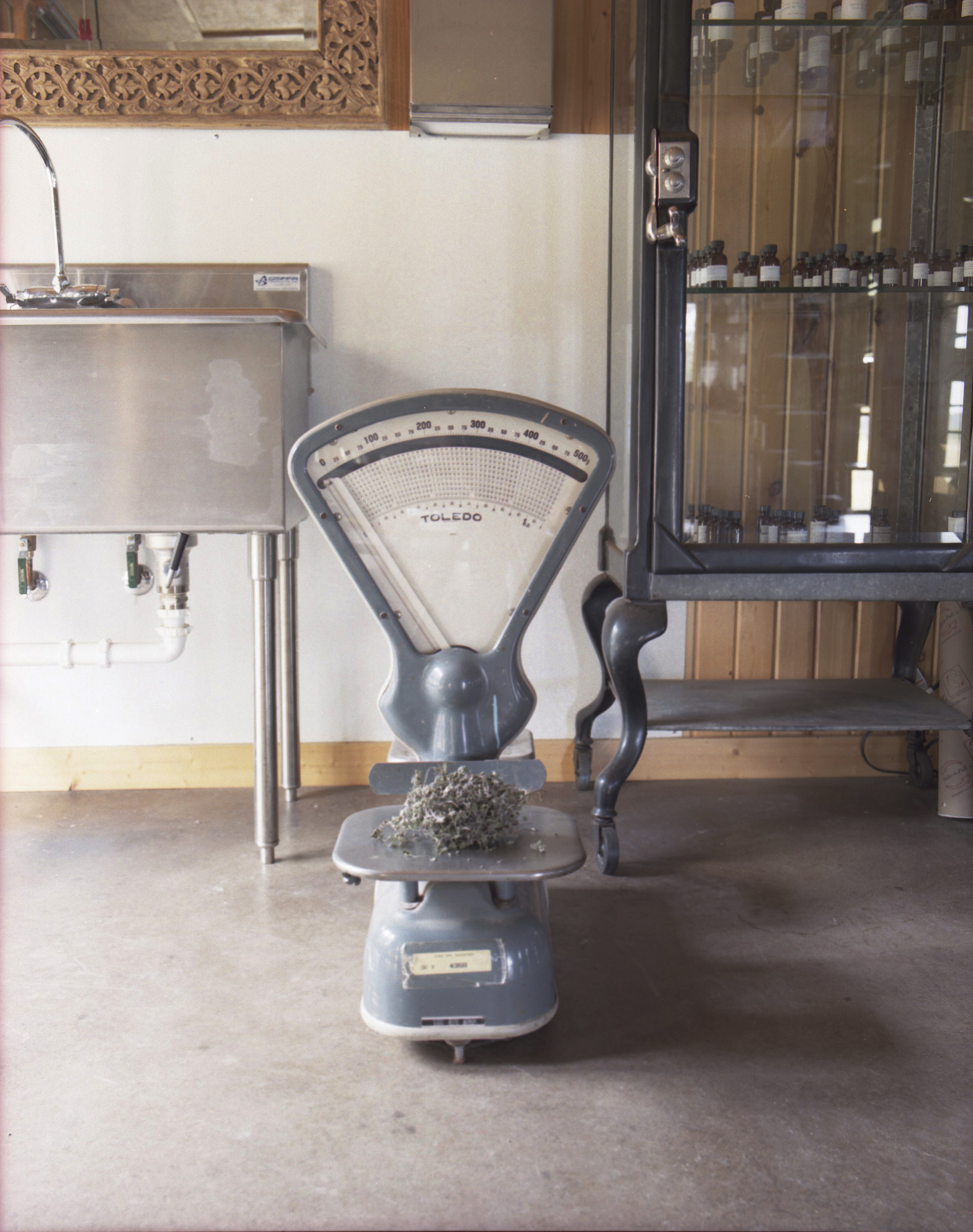
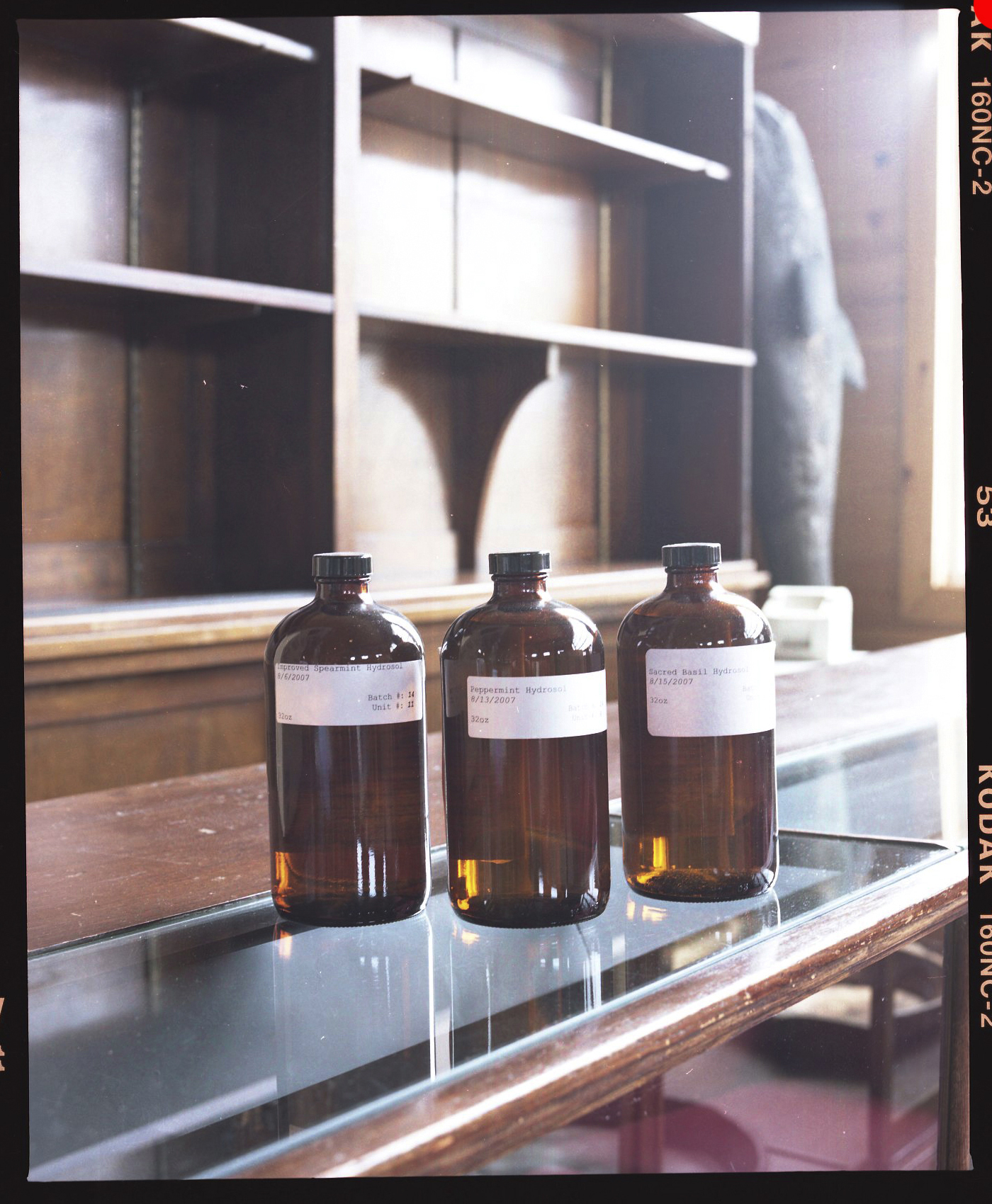
Outside the barn where the distillation of Rechelbacher’s homegrown holy basil, rosemary, oregano, marjoram, thyme and peppermint takes place, he confesses that the 19 huge bird shaped pillars out front, ‘Just turned up one day on a couple of trucks. We’d forgotten we bought them 3-4 years earlier on a trip to Turkey.’ Inside the barn is filled to the rafters with beautiful antique furniture – an entire 18th century room set, Josef Hoffmann and Michael Thonet chairs, antique perfume cabinets (‘I might use these to decorate my New York store’, he muses). His home, too, is like a mini Hearst castle with 18th century Hapsburg dining chairs, Indian pillars and gewgaws from across the globe. Rechelbacher admits, ‘When I was a kid growing up in Klagenfurt, Austria, we had nothing. My father had been a prisoner of war and worked as a cobbler. We’d go and look at all these houses. But we had nothing. Later I began accumulating all this stuff when we went to auctions. It became like an addiction’. Nowadays, he is trying to divest himself of the obsession. ‘I am practicing non-attachment,’ he says adding. ‘It is all for sale.’
Rechelbacher’s transformation into an organic guru started in the 60s, when he was ranked among the world’s top hairstylists. The Austrian superstar travelled the world doing hair shows until1964 when he was involved in a near fatal car crash in America and was forced to stay on in Minneapolis to work off his hospital debt. In quick succession, he fell in love, got married and opened a salon in Minneapolis. Ever the entrepreneur, he soon launched his first hair care product, a hairspray. ‘It was an aerosol and loaded with PVC, which was one of the stiffening agents,’ he says, narrowing his owlish eyes at the memory. ‘Hairdressers like to spray the living daylight out of things and I used a lot of hairspray. But one Saturday people started passing out in the salon because the air was so bad.’
A year later, the chemical build up in the salon started to affect him too. ‘I just couldn’t get up one morning. I thought I had the flu. I was really drained’. Fortunately his mother, a trained herbalist was visiting from Austria. ‘She had warned me about the chemicals in the salon. But I didn’t listen,’ he admits. She gave him enemas and forced him to drink 4 litres a day of her homemade nettle brew. ‘It is very Austrian. It is to flush out your kidneys and clean the liver. It took about 3 weeks before I felt really good.’
Getting sick was the catalyst that awakened his interest in health. He took up yoga and meditation. He travelled to India and studied with guru Swami Rama and in 1968 he developed a new healthier line of hair products with his mother’s help. ‘We were so eager to do the right thing. I made her put everything in that I could find that was good.’ The resulting clove shampoo was a sludgy brown herbal mix. ‘I showed it to one of my clients and she said “Yuk! You are not putting that on my hair!” She was a blond, so I went over to a brunette and said, “Look I’ve created a shampoo for brunettes.”’ Soon after he created a chamomile shampoo for blonds and one with blue malva herbs for color-damaged hair.
When Aveda launched in 1978 (the name means ‘all knowledge’ in Sanskrit), it was a continuation of those early products. Rechelbacher is the first to admit that many of the early Aveda products contained chemicals that he wouldn’t touch today. ‘We added preservatives so it would last forever. We added cocamide and sodium lauryl sulfate [both carcinogens according to Epstein’s book]. We were told it was from coconut, but it was from petrochemicals. And we were using parabens [hormone disruptors according to Epstein]. Most of the industry still uses these ingredients. But now we use essential oils as preservatives. They won’t allow any impurities to grow they are anti-bacterial and anti fungal.’ The downside is that natural ingredients can be very expensive. Conventionally grown rose essential oil is $1,500 to $2,000 a kilo, and organic is $7-10,000 a kilo wholesale, he says.
In 1997, Rechelbacher sold Aveda to Estee Lauder for $300 million. To say he is not happy about how Aveda has since evolved is an understatement. ‘It makes me so angry. They’ve started reformulating the products to make them cheaper and to make more profit.’
The next day we drive an hour into Minneapolis to visit the Intelligent Nutrients factory and showroom (formerly the Aveda factory). Rechelbacher is checking on the production of a batch of conditioner. It is a 12-hour process with a giant mixer slowly stirring the ingredients together in a big metal tank. In the lab Barbara Fealy, a formulation chemist, is testing out a new lipstick. It is colored with purple corn. ‘He challenges us to come up with new ways of doing things and break rules. You are not going to be instantly successful. It can take two or more years,’ she says.
The toxins in lipstick are a favorite topic. ‘The stuff they put in to make it kiss-proof is a plastic coating. ‘ he says. ‘Those silicones don’t break down. They are not recyclable. It will slowly but surely kill you as it spreads through the body. And the so called ‘natural mineral colors’ in lipstick. They are a rip off. They are all toxic metals. The colors come from iron, coal, cobalt and lead.’ Rechelbacher’s own Intelligent Nutrients lipstick line (which he hopes to launch later this year) will use beets, corn, blueberries, strawberries, turmeric and blue chamomile as colorants. ‘We will need very good packaging as the natural colors are very light sensitive,’ he says.
While Intelligent Nutrients is quickly gaining a fan base in the US in top stores like Barneys, ABC Carpet and Home, and Wholefoods, and internationally in countries such as Hong Kong, Singapore and Germany, the line is not yet available in the UK. He is in discussion with Selfridges to start selling later this year. In the meantime, Rechelbacher advises Brits to do their own research and not take the manufacturers word, or his word, for their product’s safety. ‘It is of the utmost importance for consumers to learn to read the labels and know what is in their products’. Lists of all the most noxious ingredients are available in books like Epstein’s and also No More Dirty Looks by Siobhan O’Connor and Alexandra Spunt and on websites like http://www.safecosmetics.org and www.cosmeticsdatabase.com, which ranks name brand beauty and body products based on their toxicity levels.
Rechelbacher, age 69, could easily retire on his sizable fortune. But his mission to change the beauty industry is all consuming. He works 7 days a week, gets up at 5am and exercises for an hour every morning in his swimming pool. ‘I used to do yoga, but this is more fun,’ he says. When he is not in his lab dreaming up new formulas, he jets all over the globe promoting his new line. Considering his original health crisis, he counts himself very lucky to still be here. ‘All my old colleagues are dead of bladder, liver and lung cancer. Hairdressers don’t live long lives.’
NOTE: In 2024, the cosmetics and beauty industry in the US is still largely unregulated. According to the FDA.gov website ‘The law does not require cosmetic products and ingredients, other than color additives, to have FDA approval before they go on the market’
 Lucie Young